



Securely Packaged with Additional Functions
SCHREINER MEDIPHARM
Securely Packaged with Additional Functions
Enhanced security, sustainability, digitalization—the demands made on modern syringe packaging keep growing. With Cap-Lock for the SCHOTT TOPPAC® infuse COC syringe, Schreiner MediPharm has developed a label that transfers key protective and security functions directly to the primary container. The combination of the label and the syringe opens up new opportunities for the entire pharma supply chain.

Demand for New Solutions
Packaging of prefilled syringes entails special challenges. In addition to protecting and marking the drug, issues such as product safety, traceability, digitalization, and process optimization are gaining increasing importance. Especially in hospitals and while preparing anesthesia trays, users frequently work under severe time pressure. Even so, shelf life, identity, and integrity of every single syringe must be reliably checked. At the same time, sensitive substances need to be protected against light and oxygen, and mix-ups must be avoided as much as possible. Traditional blister packs can perform protective and security functions but at the same time increase the packaging effort as well as transportation and storage volumes.
Tamper Evidence on the Primary Container
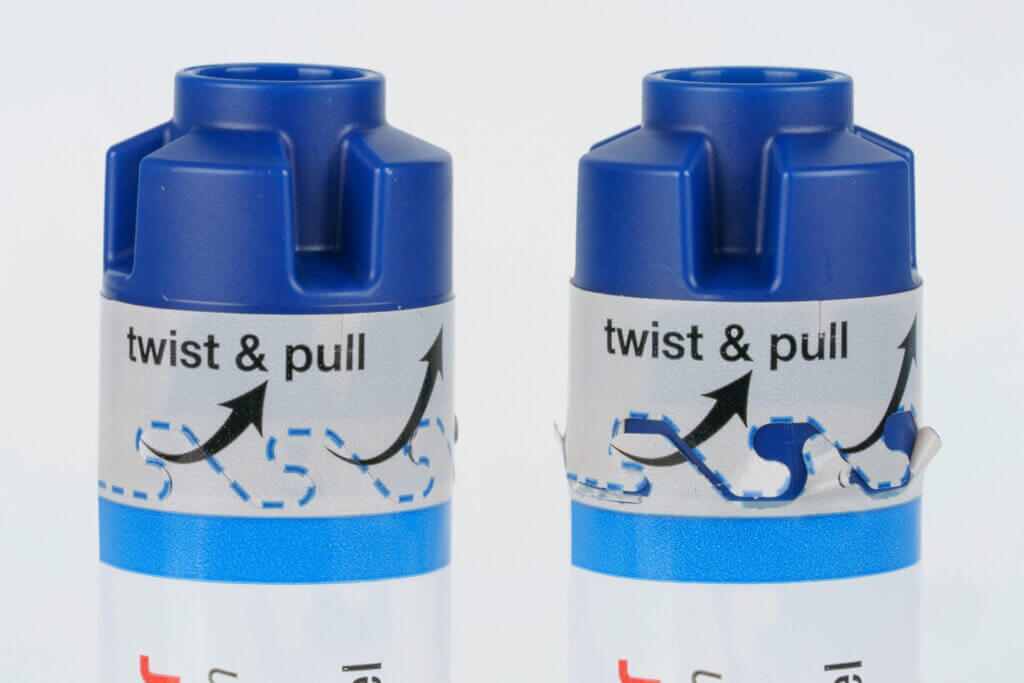
This is exactly where the joint packaging concept from Schreiner MediPharm and SCHOTT Pharma comes into play. The SCHOTT TOPPAC® infuse COC syringe has a specially developed cap whose diameter corresponds to the syringe body. As a result, the Cap-Lock Label from Schreiner MediPharm can be applied to the syringe body and cap in a reliable process, wrapping around both components like a second skin. The special characteristic of this solution is that the label’s performance features go far beyond mere marking purposes. It delivers functions that blisters have predominantly been performing so far and beyond: When opening it for the first time the label is irreversibly damaged and makes tampering attempts immediately visible. A label-integrated RFID chip further enhances security by enabling digital first-opening indication on unit level. That protects product integrity from production to final use.
Added Value Due to Multifunctionality
At the same time, the Cap-Lock Label— depending on the respective application— can offer multi-level UV and light protection, a gas barrier, or extended space for information. In addition, due to integrated RFID functionality, every single syringe becomes a digital information carrier, enabling realtime identification of drugs, inventory management, and seamless tracing of products. This supports automated workflows in hospital pharmacies or the supply chain. For pharmaceutical manufacturers, there’s another benefit: The label can be integrated into existing labeling processes without any application of heat, thus not requiring any complex modifications on the primary container.
More Efficient Packaging
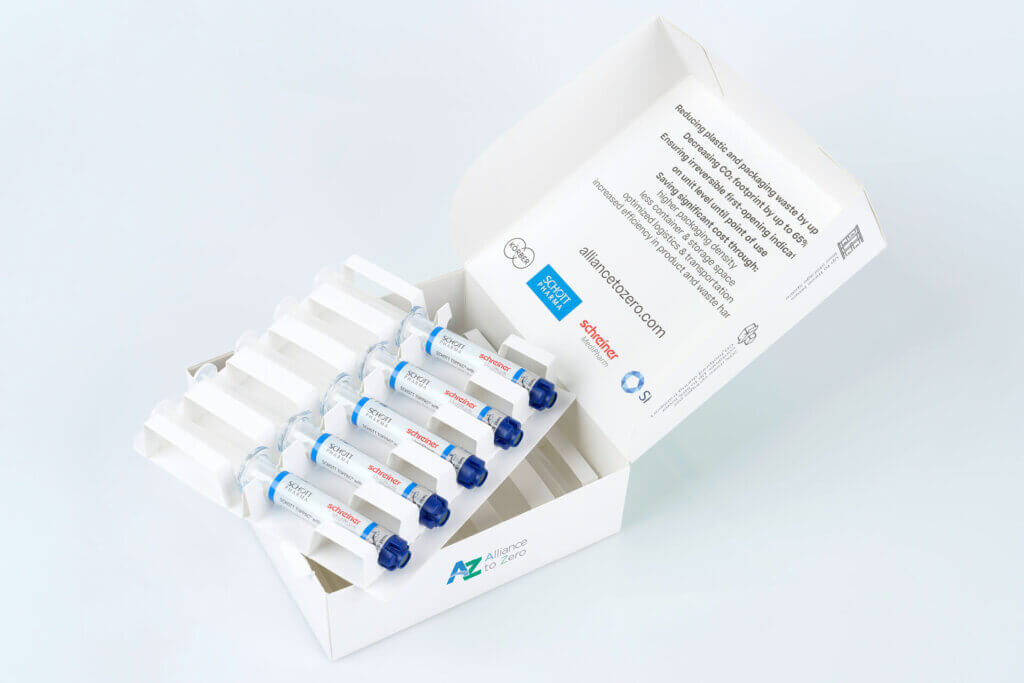
The Cap-Lock Label was developed as a component of a holistic packaging concept. Together with volume-optimized top-load mono-material box packaging, higher packing density can be achieved compared to a conventional blister solution. On the example of 5-ml syringes, the comparison data obtained in the project show that up to 20% more units can be transported per container. In addition, storage space requirements in hospitals are significantly reduced along with savings in packaging materials and a CO₂ footprint reduction of up to 58% in transportation.
A Key Component for the Next Generation of Packaging Concepts
The Cap-Lock Label shows how protective, security, and digital functions can be implemented in an integrated system. Together with the SCHOTT TOPPAC® infuse, a solution is created that transforms the primary container itself into a functional type of packaging. For pharmaceutical manufacturers, that opens up new opportunities to adapt packaging concepts to the growing demands of modern biopharmaceuticals and digitalized supply chains.